
A handful of new staff have joined the Research Computing Centre this year to help deliver multiple new projects throughout The University of Queensland.
The staff are working on a diverse range of projects, including development of the new RCC services portal; partnerships in software development with UQ’s Data Science Collaborative Research Platform (CRP); operations of the ARDC Nectar Research Cloud; and business analysis for various functions across the University.
RCC Director Jake Carroll said the investment in staff will pay UQ back in research outcomes, impact and long-term sustainaility.
“Our people are our most valuable and important resources in the provision of our world class digital research infrastructures,” said Jake.
“I am so pleased to see this set of activities taking place with our wonderful new staff, and it puts us in an excellent position for 2026, which is promising to be an exciting year full of innovation and new capabilities for UQ.
“The best bit of my day is watching staff grow, achieve and enable research and innovation.”
The RCC services portal will replace an outdated system with a modern stack that will improve the efficiency of storage and compute allocation and management, provide a consistent workflow for storage and compute allocation applications, and provide a user-friendly reporting dashboard for information about RCC’s services.
The Data Science CRP provide expertise in bioinformatics, statistics, biometry, and applied AI to researchers.
RCC has long assisted in the operations of the Queensland node of the ARDC Nectar Research Cloud, a national cloud computing service for Australian researchers. With the service, researchers can use scalable computational resources, run software, host research platforms and applications, and store and access data remotely and at scale.
Introducing some new RCC staff members
Pravesh Kumar
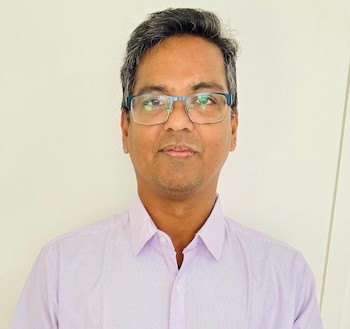
Pravesh Kumar has joined RCC’s Research Software Development team as a Research Software Engineer.
He will work closely with a number of UQ groups on full-stack application delivery, and to help these groups make the most of the University’s eResearch capabilities available through RCC.
Pravesh is a returning hire, with more than five years of experience previously working at UQ. He worked on the implementation of business management processes for various UQ stakeholders and converted manual paper-based application forms to automated workflow forms as part of UQ Unitask.
Overall, Pravesh has more than 10 years of software development experience across education, government and financial sectors, and has leveraged a wide range of diverse technologies tailored to project needs.
About his new role at RCC, Pravesh said he is looking forward to applying his experience in software engineering to help build scalable, sustainable solutions, and to work closely with researchers and technologists.
“I was driven by the opportunity to contribute to a forward-thinking research computing environment and collaborate with a team that’s deeply engaged in enabling impactful science,” he said.
“I was drawn to RCC’s commitment to innovation and its role in supporting cutting-edge research across disciplines.”
Matthew Russell

Matthew Russell has joined RCC as a Full Stack Developer to work on the development of the new RCC services portal.
Matthew brings experience in portal development in the academic sector to the team.
Armed with a Bachelor Degree in Information Technology from Griffith University, Matthew had a long IT career at Griffith, most recently managing its Social Analytics Lab (SAL).
SAL is a custom-built, secure research facility housed at Griffith University to store, manage and analyse sensitive administrative data for research and teaching. It is an air-gapped facility, and stored data from Queensland Police Service, Queensland Correctional Services, and Queensland Health.
“We had over 80 researchers working across 50 different projects to produce over 100 outputs (publications, theses, presentations, etc.),” said Matthew.
At Griffith University, Matthew also worked as a Systems Engineer on a project to replace old hardware in the university’s data centres, which included migrating applications off outdated virtual machines.
Prior to that role, Matthew was a Senior Systems Administrator in Griffith University’s server team, managing its fleet of more than 800 Windows Servers, and also held several desktop and AV support roles.
Most recently, Matthew worked as a Software Engineer at Pxel, a Brisbane-based web development agency.
Matthew said he decided to join RCC as he was keen to work with a supercomputer, and with HPC Bunya, “UQ has the largest one in the state.”
“I love the environment of research computing where I can apply my IT skills to facilitating research. I'm excited to apply my systems engineering background to software development and build tools that improve workflows, user experiences, and grow RCC's service offerings,” said Matthew.
Joshua Maloney

Joshua Maloney has joined RCC as a Systems Administrator to work on a number of projects. These include assisting with the operations of the Queensland node of the ARDC Nectar Research Cloud; improving the user experience of UQ supercomputer Bunya; building tools to monitor and reduce GPU idle time; updates to Bunya’s operating system and scientific software; and collaborating with research groups to provide data storage and infrastructure.
Joshua first started at UQ as an undergraduate student, studying physics and then maths and computer science.
“I never would have expected my journey to come full circle, but I’m super happy to be in the Research Computing Centre,” said Joshua.
“Since I’ve been here [at RCC], I’ve been astounded by the range of expertise and the complexity of systems that are involved. While I’m here, I’m looking forward to helping researchers meet their research goals, and in some way being able to make an impact with new and novel ideas,” he said.
Joshua’s early career involved developing 3D graphics applications for local startup companies, including urban planning and architectural visualisation.
He has also worked for Australian computer software company Euclideon on its “Unlimited Detail” middleware 3D graphics engine, and has made simulation software for aircraft company Boeing.
Most recently, Joshua was in the video games industry where he worked on the unreleased Indycar game.
“I’m also proud of working on the game Age of Empires II, which we ported to PlayStation earlier this year,” he said.


